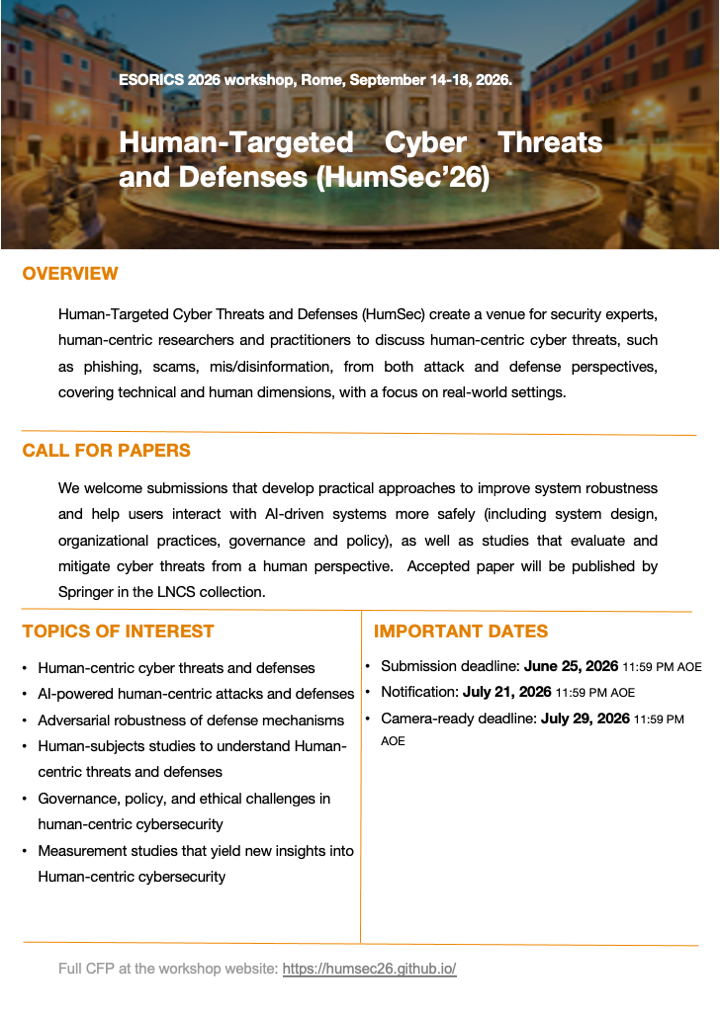
Overview
Human-targeted cyber threats exploit how humans perceive and interact with systems to bypass security defenses, rather than targeting technical vulnerabilities alone. Many attacks rely on social engineering, shaping users' trust, attention, and decision-making to achieve their goals. This includes a wide range of phenomena such as phishing, scams, misinformation/disinformation, and other forms of online manipulation. Recent advances in AI have made these threats more scalable and more convincing, while also changing how systems are built and used. At the same time, understanding human behavior has become increasingly important for designing effective protections.
Keynote Speaker

Giovanni Apruzzese
Assistant Professor at Reykjavik University, IcelandMore about Giovanni.
Giovanni Apruzzese is an Assistant Professor within the Department of Computer Science at Reykjavik University, Iceland. Prior to this, he was affiliated with the Hilti Chair of Data and Application Security at the University of Liechtenstein---first as a PostDoc and then as an Assistant Professor. He obtained the PhD in Information and Communication Technologies at the University of Modena and Reggio Emilia (Italy) in 2020. He authored over 50 peer-reviewed papers at internationally-recognized research venues. His research interests encompass a variety of themes, most of which revolve around cybersecurity and artificial intelligence, but he also appreciates topics within human-computer interaction. His primary expertise lies in network security and in phishing detection. Giovanni also puts a lot of effort in servicing the scientific community, and he was awarded numerous recognitions for his reviewing duties in leading computer-science venues. He is the General Chair of IEEE SaTML 2027, one of the PC Co-chairs of ACM AISec 2026, one of the PC Vice-chairs of USENIX Security 2026, and has been an Associate Editor for ACM TAISAP since 2025, and an Area Chair for NeurIPS since 2024. Due to his interest in reviewing and his servicing committments, he has also recently engaged in researching the usage of large-language models for scientific peer reviewing.
Misleading Large Language Models used (or misused) in Scientific Peer-Reviewing via Hidden Prompt-Injection Attacks
Large Language Models (LLMs) have revolutionized many aspects of our society. Many tasks encompassing document summarization or autonomous content generation can now benefit from the capabilities of LLMs. Among these, a domain in which LLMs are receiving incresing attention is that of scientific peer reviewing. Yet, usage of LLMs in this context must be done with due care: LLMs have certain blind spots which, if exploited, can lead to detrimental effects to the human requesting the service of an LLM.
In this talk, Giovanni will outline the reasons why the author of a scientific paper may want to mislead an LLM tasked to review a given paper. Based on these reasons, He will then explain ways in which one can reach their goal via "hidden prompt injections". Finally, He will discuss the results of a large-scale systematic analysis wherein they studied the impact of prompt-injection attacks against commercial LLMs (e.g., ChatGPT, Gemini). In doing so, He will also outline potential countermeasures---as well as counter-countermeasures. The takeaway is that blind reliance on LLMs for peer-review duties is strongly discouraged, and human oversight is still necessary.
Schedule
The workshop will be held on September 18, 2026 from 13:50-17:30 CEST.
Accepted Papers
Revisiting Deceptive and Malicious Advertisements in the Wild
From Fire Safety to Cybersecurity: Exploring the Role of Stress Exposure Training for Incident Response
Modeling Human-Behavior Effects on Ransomware Resilience with Stage-Wise Markov Chains
Redesigning Trust: Replacing Dark Patterns with Fair Choice Architecture in Financial Interfaces
Exploring Usability and Security Perceptions of Panic Passwords Against Coercion
Inference Attacks and Defenses on LLM-Powered Phishing Email Detection Systems
Assessing URL Literacy in an Enterprise Setting
Usability Evaluation of Loki as a Coercion-Resistant Internet Voting System
In Situ Key-Blocking using Trajectory Constraints to Avoid Reuse of Passwords
Call for Papers
We welcome submissions that develop practical approaches to improve system robustness and help users interact with AI-driven systems more safely (e.g., system design, organizational practices, governance and policy), as well as studies that evaluate and mitigate cyber threats from a human perspective. We also welcome Systematization of Knowledge (SoK) papers, position papers and other empirical research related to the topics below.
Important Dates
Submission deadline:
June 25, 2026July 10, 2026 11:59PM AOENotification: August 2, 2026 11:59PM AOE
Camera-ready deadline: August 14, 2026 11:59PM AOE
Early registration deadline: August 10, 2026
Workshop registration is recommended by August 14, 2026
Online Registration close on September 4, 2026
Topics of Interest (but not limited to)
-
Understanding, Measuring, and Characterizing Human-Targeted Cyber Threats
-
Human-subjects studies (e.g., surveys) on online fraud, scams, phishing, misinformation/disinformation, harassment and online abuse
Measurement studies that yield new insights into Human-Targeted Cyber Threats (e.g., bottlenecks)
-
Analysis of attack infrastructure (e.g., phishing kits ecosystems)
-
AI-driven generation of human-targeted attacks
Emerging human-centric threats that exploit human vulnerabilities (e.g., urgency, fear, curiosity)
-
Studies identifying gaps between existing defenses and real-world threats
Governance, policy, and ethical challenges in human-centric cybersecurity
-
-
Countermeasures to Mitigate Human-Targeted Cyber Threats
AI-powered defense mechanisms against human-targeted attacks
Machine Learning or other advanced techniques for detecting and mitigating human-targeted threats (e.g., phishing detectors)
Human factors in the design, usability and effectiveness of defense mechanisms
-
Security and privacy in human-centric systems
Adversarial robustness of defense mechanisms
Security education and training
Submission Guidelines
Submissions must not substantially overlap with previously published papers or with works that are simultaneously submitted to a journal or a conference/workshop with proceedings.
-
Submit. Please submit your papers via EasyChair.
-
Format. Papers must be written in English, submitted as a single PDF file, anonymized for double-blind review, and must follow the official LNCS template.
-
Length. Long papers are limited to 16 pages and short papers to 8 pages, excluding references and appendices. Note that reviewers are not required to read the appendices.
-
Publication & Presentation. Accepted papers will be published by Springer in the LNCS collection. At least one author of each accepted paper will be required to register for the workshop and present the work orally or as a poster.
Open Science Expectations
We encourage authors to release code, data, and other materials needed to reproduce their work on a public platform (e.g., github or Zenodo), under an open source license. However, we acknowledge that sometimes it is not possible to share these openly, such as when it involves malware samples, data from human subjects that must be protected, or proprietary data obtained under agreement that precludes publishing the data itself. In those cases, authors can provide a clear explanation of why the data cannot be released in the "Open Science" appendix (which is not subject to the page limit at submission time).
Use of AI
The use of AI-generated content, including but not limited to text, figures, images, and code, must be disclosed in the acknowledgements section, which does not count toward the page limit at the time of submission. The use of AI tools solely for language editing or grammar improvement is considered common practice and is not covered by this policy. In such cases, disclosure is not required.
Downloads
Downloads the workshop poster: Poster image.
Organizers
General Chairs
Eugenio Nemmi, Sapienza University of Rome, Italy
PC Chairs
Ying Yuan, ARC, Örebro Univeristy, Sweden
Eugenio Nemmi, Sapienza University of Rome, Italy
Qingying Hao, ShanghaiTech University, China
Program Committee
Giovanni Apruzzese, Reykjavik University, Iceland
Alessandro Brighente, University of Padua, Italy
Mauro Conti, University of Padua, Italy & Örebro University, Sweden
Federico Cernera, Sapienza University of Rome, Italy
Xiaowei Chen, Max Planck Institute for Security and Privacy (MPI-SP), Germany
Xinfan Guo, Imperial College London, UK
Chaoxiang He, Shanghai Jiao Tong University, China
Zilong Lin, University of Missouri-Kansas City, USA
Ruofan Liu, National University of Singapore, Singapore
Kyungchan Lim, University of Maryland, USA
Luigi V. Mancini, Sapienza University of Rome, Italy
Alberto Maria Mongardini, Technical University of Denmark, Denmark
Antonino Nocera, University of Pavia, Italy
Irdin Pekaric, University of Liechtenstein, Liechtenstein
Yunan Peng, Imperial College London, UK
Margie Ruffin, Spelman College, USA
Advije Rizvani, University of Liechtenstein, Liechtenstein
Angelo Spognardi, Sapienza University of Rome, Italy
Zhibo (Eric) Sun, Drexel University, USA
Francesco Sassi, Sapienza University of Rome, Italy
Feng Wei, Artificial Intelligence Institute, China Academy of Information and Communications Technology, China
Binbin Zhao, Zhejiang University, China